
CREDI is an onchain private credit platform that lends stablecoins to businesses against short-term receivables: B2B invoices from UK companies and card payments waiting to settle. Depositors put USDC into a CREDI vault on Ethereum, CREDI advances that capital to vetted businesses, and the repayments fund the depositors' yield (CREDI). CREDI is a Turtle partner, and its CREDI USDC Vault is open to deposits in the Turtle app (Turtle app).
The idea behind CREDI is simple to state and hard to execute. Small and mid-sized businesses wait weeks to get paid on their invoices and days for card payments to settle, and banks are slow to finance that gap at small ticket sizes. Stablecoin holders, on the other side, look for yield that comes from somewhere outside crypto trading. CREDI sits between the two: it underwrites the receivables the way a traditional lender would, then settles the money onchain so depositors can see where it goes. When CREDI went live on Turtle, it described the offer to depositors as "yield backed by real payment flows" (CREDI on X).
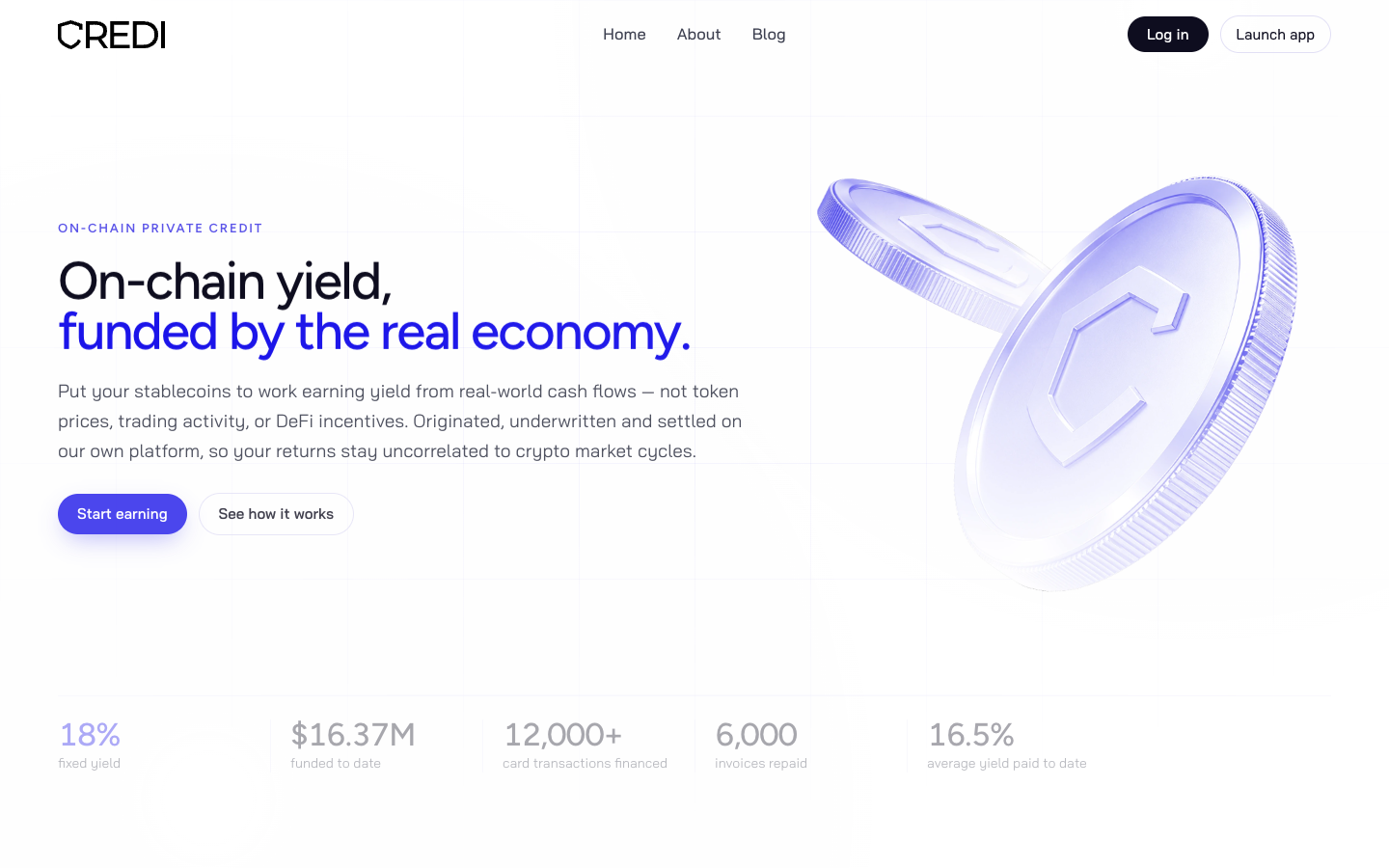
CREDI, homepage, November 2026.
What does CREDI finance, and where does the yield come from?
CREDI lends against two kinds of short-term receivables, and both follow the same pattern: a business has money coming in, CREDI pays part of it upfront, and the business's customer or payment network repays CREDI when the money arrives (CREDI, CREDI About).
| Asset class | Live since | What gets financed | Weighted average life |
|---|---|---|---|
| Invoice finance | 2024 | B2B trade receivables from UK businesses, advanced against legally assigned invoices | 45 days |
| Onchain receivables | 2025 | Card and transaction receivables financed while they settle, through the Visa Ramp Provider Program | 7 days |
-
Invoice finance is the older business. A UK company delivers goods or services and issues an invoice with 30, 60 or 90 days to pay. CREDI buys the right to collect that invoice, advances part of its value to the company straight away, and collects the full amount when the customer pays. The company gets working capital the same week.
-
Card receivables run on a shorter clock. When a merchant takes a card payment, the money takes a few days to reach its account. CREDI finances that settlement window through the Visa Ramp Provider Program. Turtle summarized the mechanics in its own post on the vault: CREDI "advances up to 80% on approved card transactions, settled in 2 to 5 days" (Turtle on X).

In both cases the yield comes from the businesses paying for early access to their own money. That is the core of CREDI's pitch: depositor returns depend on businesses repaying short-term credit, and the rate is set when you deposit, so it does not follow token prices or trading volumes.
Short duration is what makes the model work for an onchain vault. Invoice loans average 45 days and card receivables average 7 days, so the book turns over many times a year and each dollar is exposed to any single borrower for days or weeks. CREDI originates every deal itself, and its site states that nothing is listed for depositors to browse: each receivable is sourced, underwritten and legally assigned before any money moves.
CREDI publishes its track record on its homepage. As of November 2026 it reports $16.37M funded to date, more than 12,000 card transactions financed, 6,000 invoices repaid and zero realised losses since inception, with the book attested by Accountable and Chainlink (CREDI). These are CREDI's own figures, and the attestations are the way to check them.
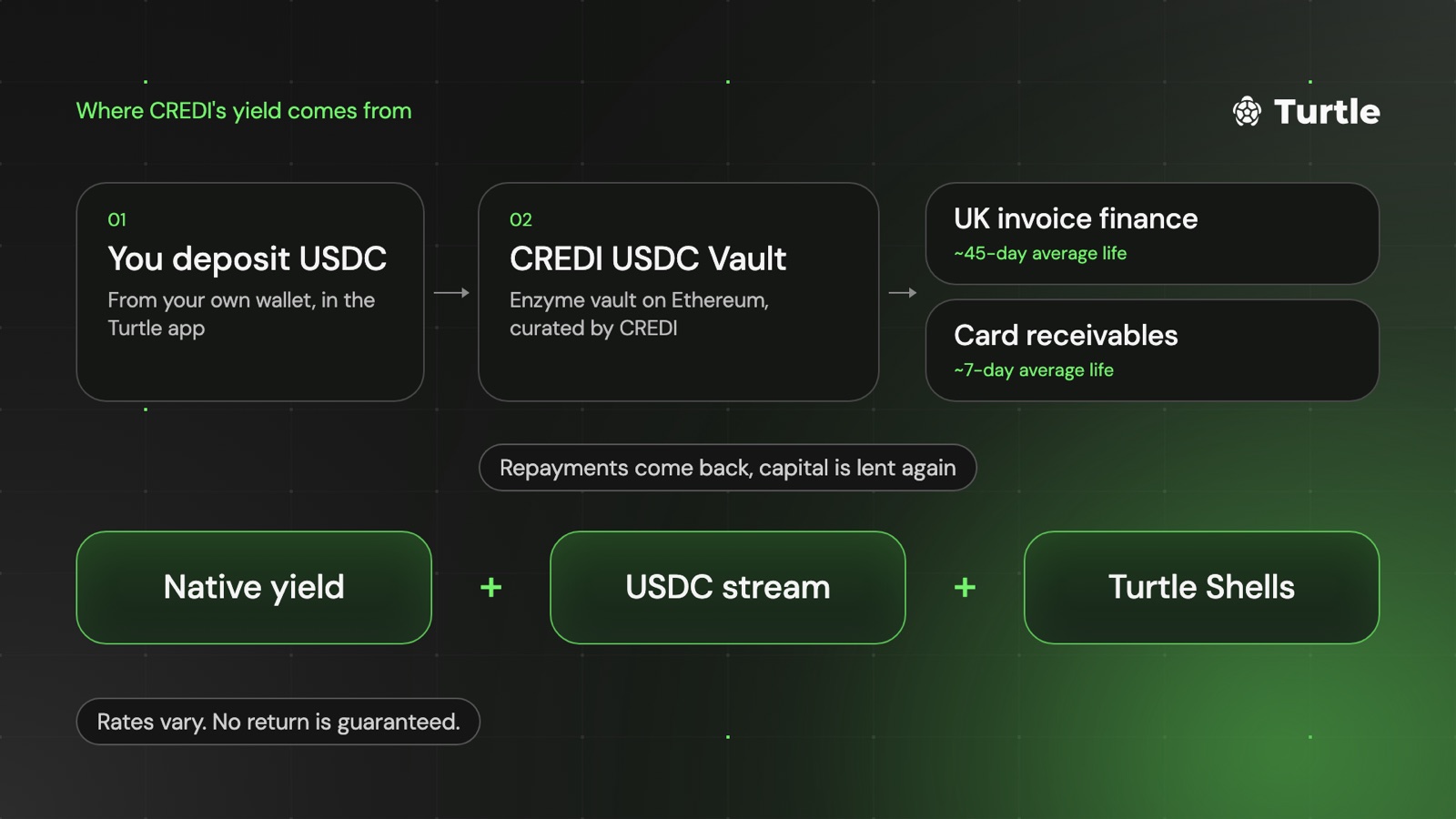
Where CREDI’s yield comes from, from your deposit to the three reward sources.
Who is behind CREDI?
CREDI is a trademark of Phoenix Labs Ltd, and its team presents itself as credit underwriters first and onchain builders second (CREDI About). The background explains why.
Founder and CEO Alessio Marinelli spent fifteen years pricing credit risk at KPMG and Deloitte and a decade in structured finance across Asia. He then co-founded Monetalis and served as its Chief Risk Officer. Monetalis was an appointed arranger for MakerDAO and built some of the first bridges between traditional finance and DeFi, including the Clydesdale and Coinbase Custody vaults, with $1.7bn managed at peak. CREDI applies the same discipline to business credit: short maturities, legal claims on the assets, and a reserve structure in front of investor money.
Torben Jorgensen, the original CFO of MakerDAO, sits on CREDI's board as finance advisor, after structured finance roles at Saxo Capital Markets and A.P. Moller-Maersk. Pedro Cerdeira leads partnerships, with over 25 years of enterprise sales and business development at Oracle, EMC, HP and Accenture, and a former General Partner seat at 3Comma Capital.
The team talks through the model in public. Marinelli joined UpBlock's live show on X to explain how business loans can earn yield onchain (CREDI on X), and the company launched a new website in November 2026 with a clearer breakdown of its vaults and processes (CREDI on X).
How does the CREDI USDC Vault work on Turtle?
The CREDI USDC Vault is an Enzyme vault on Ethereum, curated by CREDI and listed in the Turtle app as a private credit deal. Turtle is the distribution layer: it lists the vault, adds its own incentives on top, and lets you deposit, track and claim from one place. You deposit USDC from your own wallet, and Turtle never holds your funds; you sign every transaction yourself (Turtle docs).
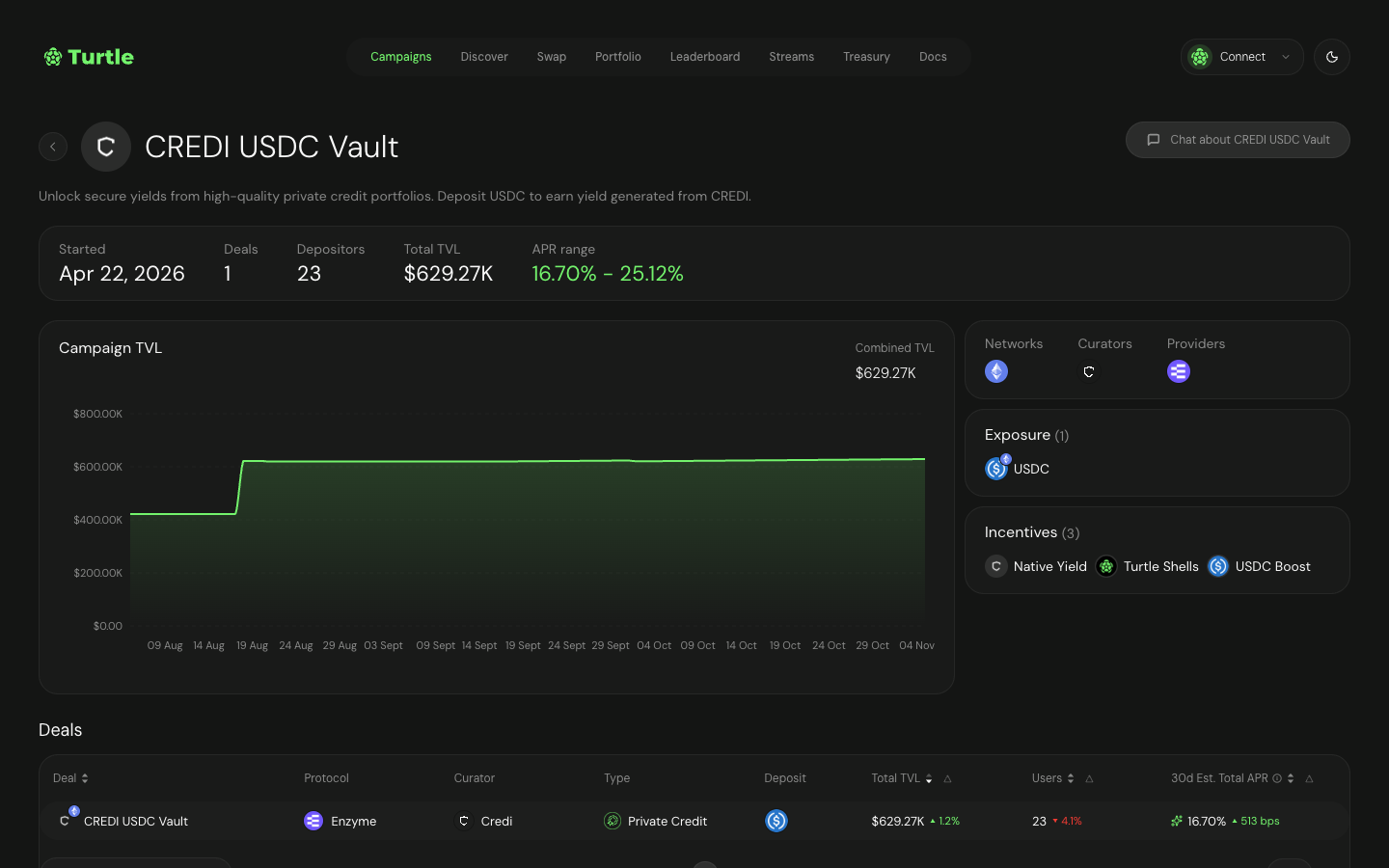
Turtle app, CREDI USDC Vault page, November 2026.
Follow one deposit through the system: your USDC enters the Enzyme vault on Ethereum. CREDI deploys the vault's capital into approved receivables, mostly card payments that settle within days. When those payments settle, the money flows back to CREDI directly, the vault's accounting updates, and the margin becomes the vault's native yield. The same capital is recycled into new receivables many times during your lock.
On top of that native yield, the vault page shows two more reward sources. CREDI funds a USDC stream paid as a Deposit Ladder, which Turtle's docs describe as a reward paid "as a lump on each cliff day"; you must hold the deposit until a cliff to earn that tier, and withdrawing early forfeits the tier in progress (Turtle docs). Turtle adds Turtle Shells, its points, which accrue per dollar per day with no end date on this vault. All three show up in Portfolio › Earnings, where you claim them from the wallet you deposited with.
Here is what the vault page showed on November 5, 2026:
| Field | Value |
|---|---|
| Network | Ethereum |
| Vault infrastructure | Enzyme |
| Curator | CREDI |
| Deposit asset | USDC |
| Total TVL | $629.27K |
| Depositors | 23 |
| Start date in the app | April 22, 2026 |
| Incentives | Native yield, Turtle Shells, USDC Boost |
Turtle's November 2 post on the vault describes a 3-month soft lock, and CREDI's own site explains that its vaults offer lock periods from 3 to 24 months, with longer locks earning higher rates (Turtle on X, CREDI vaults). Rates move with the vault and its reward streams, so treat any figure you see in a post as illustrative and read the live APR range on the vault page before you deposit. The stream's own page in the app (Streams, then the CREDI row) lists who can earn, when it pays, the minimum hold and what leaving early costs. Match the lock to money you will not need during that period.
How does CREDI protect depositors?
Being onchain changes how CREDI settles money. The legal protection behind each loan is the same a traditional lender would ask for, and CREDI's site lays it out in four layers (CREDI, CREDI About).
The first is structural loss protection of 20% to 25% built into every deployment, which absorbs losses before they reach depositor capital. The second is legal assignment: each receivable is assigned to CREDI before any advance, so the claim is enforceable whether the asset is an invoice or a card payment, and CREDI also takes a fixed and floating charge on the borrower's assets. The third is control of cash flow: repayments go to CREDI directly and bypass the borrower, which removes the risk of a borrower collecting the money and failing to pass it on. The fourth is a second-loss reserve, funded by CREDI retaining 10% of its net revenues in the portfolio.
On transparency, the vaults run on Enzyme's audited infrastructure, Accountable and Chainlink attest the book, and CREDI's own smart contract audits are available on request. In August 2026, Starknet announced an integration that lets CREDI prove its collateral and vault accounting while keeping borrower data confidential (Crypto Briefing).
None of this removes risk, and CREDI says so plainly in its FAQ: "No structure is risk free." The risks worth weighing are borrower defaults larger than the loss protection, an operational or legal failure at the originator, smart contract risk in the vault, and lock-up risk if you need the money before your cliff. Plan as if your USDC stays in for the full lock.
Why did Turtle and CREDI partner?
Turtle's catalog widened in 2026 from DeFi lending into payment finance, private credit and other real-world assets, and CREDI was one of the nine deals that went live in the second quarter (Turtle Q2 2026 update). Turtle introduced the partnership on X as "bringing private credit onchain with @credilabs" (Turtle on X), and CREDI pinned its own launch post, "CREDI is live on @turtledotxyz", on July 24, 2026 (CREDI on X).
The fit works both ways. Turtle depositors get a USDC position whose yield comes from business repayments, with short loan durations and a team that has run real-world asset vaults at scale. CREDI gets distribution: its vault reaches Turtle's depositors and the partner apps that show Turtle deals, with rewards streamed and tracked in the same app.
How do I deposit into the CREDI vault?
Open the CREDI USDC Vault in the Turtle app and connect your wallet. Read the vault terms and the CREDI stream's terms, especially the lock period, the cliff days and what leaving early costs. Deposit USDC on Ethereum and sign the transaction in your wallet. From then on, track your position and claim rewards in Portfolio › Earnings.
Browse CREDI and the other Turtle Deals at app.turtle.xyz/earn.
FAQ
Is CREDI the same as Credefi?
No. CREDI (credilabs.io) is run by Phoenix Labs Ltd and finances UK invoices and card receivables. Credefi is a separate lending project with its own CREDI token. Check the contract address on CREDI's site before you interact with any token.
Does CREDI have a token?
CREDI lists a CREDI token contract and a CREDI staking contract on Ethereum in its site footer. The token contract is 0x92c38B5dC43d180a84660c7a520A84830326930e (Etherscan). You do not need the token to deposit into the CREDI USDC Vault on Turtle.
What chain is the CREDI vault on?
It runs on Ethereum and uses Enzyme vault infrastructure. CREDI also works with Starknet on confidential, provable credit data.
Can I withdraw before my lock ends?
The CREDI USDC stream on Turtle is a Deposit Ladder: each tier pays on its cliff day, and withdrawing before a cliff forfeits the tier in progress. CREDI's site also mentions an OTC secondary market for liquidity before a term ends. Read the stream's terms in the Turtle app before depositing.
Has CREDI had any losses?
CREDI reports zero realised losses since inception, with its book attested by Accountable and Chainlink. That is a record to date, and it does not guarantee future results.
Does Turtle hold my USDC?
No. Turtle generates the transaction and you sign it from your own wallet. Your USDC sits in the Enzyme vault curated by CREDI, and Turtle cannot move or freeze it.